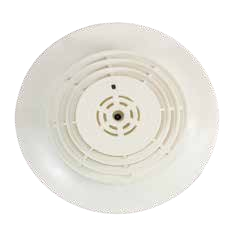

FW521 - UL 521 Listed Fixed Temperature Detector
UL Listed • Fixed Temperature • Industrial Applications
FW521
The FW521 Standard Heat Detector is a UL 521 listed fixed temperature heat detector designed for environments where smoke detectors are not suitable. With a fixed temperature rating of 135°F (57°C), it provides reliable fire detection in commercial kitchens, garages, mechanical rooms, and other areas prone to dust, fumes, or steam.
| Model Number | FW521 |
| Product Name | Standard Heat Detector |
| Detection Type | Fixed Temperature |
| Temperature Rating | 135°F / 57°C (Standard) |
| System Compatibility | Conventional Fire Alarm Systems |
| Certification | UL 521, CSFM, FM |
| Wiring Configuration | 2-Wire (Power & Signal) |
| Operating Voltage | 12-30VDC |
| Standby Current | 25μA @ 24VDC |
| Alarm Current | 45mA @ 24VDC |
| Alarm Indication | Red LED (360° visible) |
| Test Method | Functional Test via Test Switch |
| Response Time Index (RTI) | ≤ 50 (m·s)½ |
| Operating Temperature Range | 32°F to 150°F (0°C to 66°C) |
| Storage Temperature | -4°F to 160°F (-20°C to 71°C) |
| Relative Humidity | 0% to 95% RH (Non-condensing) |
| Dimensions (Diameter x Height) | 5.5" x 1.8" (140mm x 46mm) |
| Weight | 6.5 oz (184g) |
| Color | White (Standard), Ivory, Gray available |
| Mounting | Ceiling or Wall Mount |
| IP Rating | IP44 (Splash resistant) |
| Warranty | 3-Year Limited Warranty |
Standard rating for most applications
High temperature rating
Extra high temperature rating
The FW521 Standard Heat Detector is a UL 521 listed fixed temperature heat detector designed for reliable fire detection in challenging environments where smoke detectors would cause nuisance alarms or fail to operate properly. Utilizing a bimetallic thermal sensor, it activates when the ambient temperature reaches its fixed rating of 135°F (57°C).
Meets rigorous UL standards for heat detector performance and reliability.
Reliable activation at predetermined temperature threshold.
Designed for harsh environments where smoke detectors are not suitable.
Activates when ambient temperature reaches 135°F (57°C). Factory calibrated bimetallic sensor.
Meets UL 521 Standard for Heat Detectors for Fire Protective Signaling Systems.
Simple, proven technology with no moving parts for maximum reliability.
UL 521: Standard for Heat Detectors for Fire Protective Signaling Systems
NFPA 72: National Fire Alarm and Signaling Code
CSFM: California State Fire Marshal
FM Approved: Factory Mutual
IBC: International Building Code
Local Codes: Complies with most local fire codes
12-30VDC, 25μA standby, 45mA alarm. Use fire-rated cable.
Single pair for power and alarm. Maximum 20 detectors per circuit.
Screw terminals accept 12-22 AWG wire. Polarity marked clearly.
| Ceiling Height | Maximum Spacing | Maximum Area per Detector | Distance from Walls |
|---|---|---|---|
| Up to 10' (3m) | 50' (15m) | 2500 ft² (232 m²) | 4" (10cm) minimum |
| 10'-30' (3-9m) | 30' (9m) | 900 ft² (84 m²) | 4" (10cm) minimum |
| Over 30' (9m) | Consult NFPA 72 | Engineering required | Consult manufacturer |
Note: These are general guidelines. Always consult local codes and the Authority Having Jurisdiction (AHJ) for specific requirements.
Where smoke from cooking would cause nuisance alarms.
Areas with dust, fumes, or high humidity where smoke detectors fail.
Vehicle exhaust would trigger smoke detectors prematurely.
UL Listed: Meets rigorous safety standards
Reliable: No nuisance alarms from dust or humidity
Low Maintenance: No cleaning or sensitivity testing
Cost-Effective: Affordable commercial solution
Easy Installation: Simple wiring and mounting
Scalable: Easy to expand existing systems
| Feature | Heat Detector (FW521) | Smoke Detector |
|---|---|---|
| Detection Method | Temperature increase | Smoke particles |
| Response Time | Slower (heat must build) | Faster (early warning) |
| Nuisance Alarms | Very low | Possible from dust, steam, cooking |
| Suitable Environments | Dusty, humid, kitchens, garages | Clean, office, residential areas |
| Maintenance | Low (no cleaning needed) | Regular cleaning required |
| Life Expectancy | 10+ years | 10 years (recommended replacement) |
Monthly
Check for damage or obstructions
Quarterly
Test using built-in test switch
10+ years
Long service life