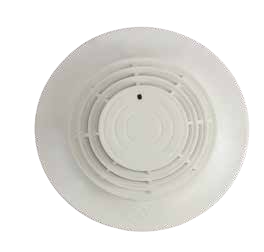

FW511 - UL Listed Commercial Grade Detector
Photoelectric Technology • UL 268 Certified • Reliable Smoke Detection
FW511
The FW511 Standard Smoke Detector is a UL 268 listed photoelectric smoke detector designed for commercial and residential applications. Featuring advanced optical sensing technology and drift compensation, it provides reliable early warning of smoldering fires while minimizing nuisance alarms.
| Model Number | FW511 |
| Product Name | Standard Smoke Detector |
| Detection Type | Photoelectric (Optical) |
| System Compatibility | Conventional Fire Alarm Systems |
| Certification | UL 268, UL 217, CSFM, FM |
| Wiring Configuration | 2-Wire (Power & Signal) |
| Operating Voltage | 12-30VDC |
| Standby Current | 35μA @ 24VDC |
| Alarm Current | 50mA @ 24VDC |
| Alarm Indication | Red LED (360° visible) |
| Test Method | Magnetic Test / Functional Test |
| Sensitivity Range | 1.5% - 4.0% per ft obscuration |
| Drift Compensation | Automatic, ±0.5% per year |
| Operating Temperature | 32°F to 120°F (0°C to 49°C) |
| Storage Temperature | -4°F to 140°F (-20°C to 60°C) |
| Relative Humidity | 10% to 93% RH (Non-condensing) |
| Dimensions (Diameter x Height) | 5.5" x 1.8" (140mm x 46mm) |
| Weight | 6.2 oz (176g) |
| Color | White (Standard), Ivory, Gray available |
| Mounting | Ceiling or Wall Mount |
| Warranty | 3-Year Limited Warranty |
The FW511 Standard Smoke Detector is a commercial-grade photoelectric smoke detector designed for reliable fire detection in conventional fire alarm systems. UL 268 listed and meeting NFPA 72 requirements, it provides early warning of smoldering fires while offering excellent resistance to nuisance alarms.
Meets rigorous UL standards for smoke detector performance and reliability.
Advanced optical sensing for early detection of smoldering fires.
Automatic sensitivity adjustment for long-term reliability.
UL 268: Standard for Smoke Detectors for Fire Alarm Systems
UL 217: Standard for Smoke Alarms
NFPA 72: National Fire Alarm and Signaling Code
CSFM: California State Fire Marshal
FM Approved: Factory Mutual
CE Mark: European Conformity
≤ 60 seconds
for smoldering fire test
2.0% ± 0.5%/ft
obscuration threshold
≤ 1 per year
industry standard
12-30VDC, 35μA standby, 50mA alarm. Use fire-rated cable.
Single pair for power and alarm. Maximum 20 detectors per circuit.
Screw terminals accept 12-22 AWG wire. Polarity marked clearly.
| Application | Spacing | Distance from Walls | Distance from Air Vents |
|---|---|---|---|
| Standard Ceiling (≤10') | 30' (9m) between detectors | 4" (10cm) minimum | 3' (1m) minimum |
| Sloped Ceiling | Follow NFPA 72 Table 17.6.3.5.1 | 4" (10cm) minimum | 3' (1m) minimum |
| High Ceiling (>10') | Engineering required | Consult manufacturer | Consult manufacturer |
Photoelectric detectors provide early warning for smoldering fires common in bedrooms.
Install in escape routes for early detection of smoke migration.
Lobbies, waiting areas, and gathering spaces benefit from early smoke detection.
UL Listed: Meets rigorous safety standards
Early Warning: Quick detection of smoldering fires
Reliable: Low nuisance alarm rate
Cost-Effective: Affordable commercial solution
Easy Maintenance: Simple testing and cleaning
Scalable: Easy to expand existing systems
| Frequency | Activity | Purpose |
|---|---|---|
| Monthly | Visual inspection | Check for physical damage or obstructions |
| Quarterly | Functional test | Verify detector operation using test tool |
| Annual | Cleaning & sensitivity test | Clean optical chamber, verify sensitivity |
| 10 Years | Replacement | Replace detector per NFPA 72 requirements |